Clinical case
An 8-year-old child is referred because the upper right central incisor has not erupted. The upper left central incisor erupted 12 months earlier. There is a midline diastema and a retained primary incisor. An upper occlusal radiograph shows a conical tooth-like structure in the midline.
Pathophysiology
A mesiodens forms due to localised abnormal proliferation of the dental lamina in the anterior maxilla. It may obstruct the eruption path of a permanent central incisor, causing delayed eruption, displacement, rotation or a midline diastema.
Epidemiology and Risk Factors
Non-modifiable | Modifiable |
|---|---|
Family history | No modifiable risk factors |
Male sex |
Clinical Features
A mesiodens is a supernumerary tooth located in the maxillary midline, usually between the maxillary central incisors. It is commonly conical and may be erupted or unerupted.
Symptoms | Signs | Image |
|---|---|---|
Failure of eruption of maxillary incisor | Delayed eruption of maxillary central incisor | 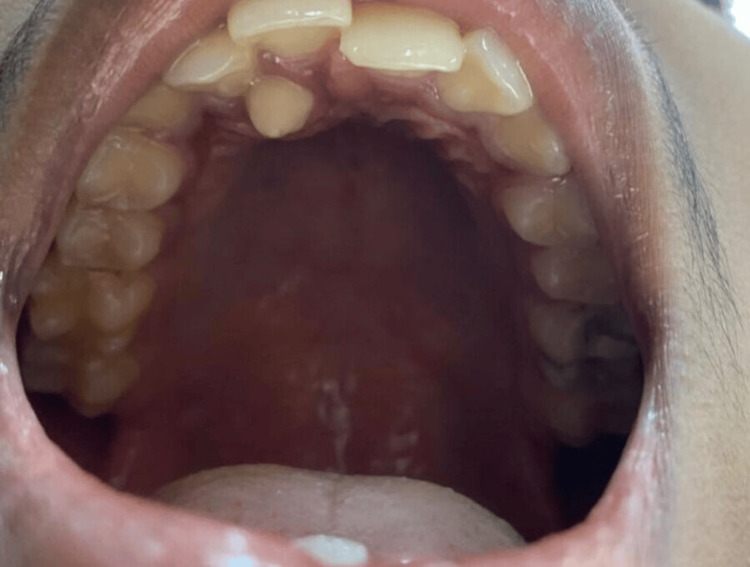 |
Midline diastema | Retained primary incisor | |
Rotation or displacement | ||
Palatal or labial swelling | ||
Conical erupted tooth |
Investigations
Primary investigations:
Full medical and dental history
Clinical examination
Radiographs: periapical radiograph; upper occlusal radiograph may be used to localise anterior supernumerary teeth; OPG can be used to assess the full dentition
Gold standard investigation:
Diagnosis is by radiographic identification of a midline supernumerary tooth, combined with clinical findings.
Investigations to consider:
Cone beam CT for more precise localisation
Orthodontic assessment
Differential diagnosis
Condition | Distinguishing features |
|---|---|
Odontome | Calcified mass or tooth-like structures obstructing eruption |
Delayed eruption without obstruction | No supernumerary seen |
Dilacerated incisor | Tooth present but root/crown abnormality affects eruption |
Trauma-related arrest | History of primary tooth trauma |
Ankylosed primary incisor | Retained primary tooth prevents eruption |
Generalised delayed eruption | Multiple teeth delayed, not isolated incisor |