Clinical case
A 12-year-old child attends because all permanent teeth are discoloured and sensitive. The teeth erupted with abnormal enamel, and several restorations have failed. The primary teeth were also affected. There is a family history of similar teeth in the father.
Pathophysiology
Amelogenesis imperfecta results from pathogenic variants affecting proteins required for enamel matrix formation, processing, maturation or mineralisation.
Genes implicated include those involved in enamel matrix proteins and enamel processing, such as AMELX, ENAM, AMBN, MMP20, KLK4 and others. Modern classifications recognise many genetic subtypes rather than a single disease.
Characteristically, amelogenesis imperfecta affects all or nearly all teeth in both dentitions, although the severity and pattern vary by subtype.
Epidemiology and Risk Factors
Non-modifiable | Modifiable |
|---|---|
Family history | No modifiable risk factors |
Sex (X-linked AMELX related disease) |
Clinical Features
Amelogenesis imperfecta is a group of inherited conditions affecting enamel formation. It causes generalised abnormalities in enamel quantity, quality or maturation.
The main recognised clinical types are:
Type | Main Defect | Appearance | Image |
|---|---|---|---|
Hypoplastic | Reduced amount of enamel | Thin, pitted or grooved enamel | 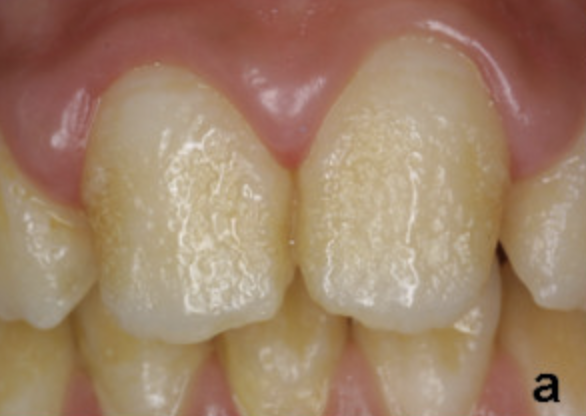 |
Hypomaturation | Enamel thickness near normal but enamel is weak or brittle due to defective maturation | Opaque white or brownish patches | 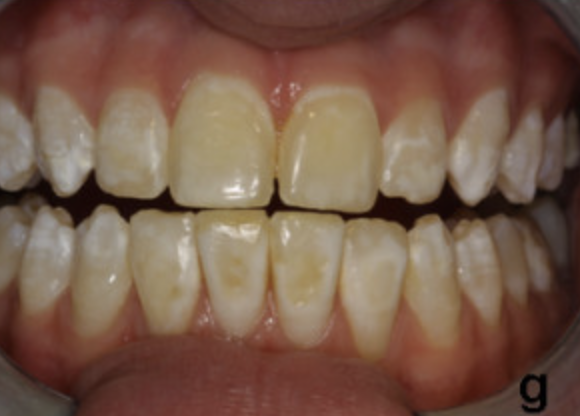 |
Hypocalcified | Enamel matrix quantity is normal but mineralisation is poor, producing soft enamel | Chalky or opaque appearance of enamel | 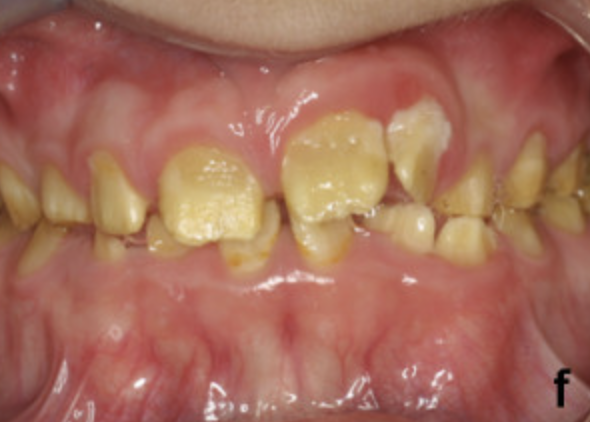 |
Symptoms | Signs |
|---|---|
Generalised discolouration | All or nearly all teeth affected |
Sensitivity | Thin, pitted or grooved enamel = hypoplastic |
Tooth wear | Soft or brittle enamel = hypomaturation or hypocalcified |
Aesthetic concerns | Yellow-brown staining |
Poor bonding/restoration failure |