Clinical case
A 5-year-old child attends because the primary teeth appear green-yellow. The parents report a history of severe neonatal jaundice requiring hospital treatment. The teeth are otherwise normally shaped and there is no history of trauma.
The most likely diagnosis is intrinsic developmental discolouration of deciduous teeth secondary to neonatal hyperbilirubinaemia.
Pathophysiology
During tooth development, circulating pigments or drugs can become incorporated into forming enamel and dentine.
In neonatal jaundice, bilirubin or related pigments may be incorporated into developing dental tissues, causing greenish intrinsic staining.
In porphyria, abnormal haem metabolism leads to accumulation of porphyrins. These may be incorporated into developing teeth, producing red, brown or purple-red discolouration.
Tetracyclines can bind calcium and become incorporated into mineralising dental tissues. Later oxidation produces characteristic yellow-grey-brown staining.
Epidemiology and Risk Factors
Non-modifiable | Modifiable |
|---|---|
Severe neonatal hyperbilirubinaemia | Tetracycline exposure in pregnancy or to young children |
Congenital porphyria | Early management of severe jaundice |
Prematurity or neonatal illness |
Clinical Features
Calcification of deciduous teeth begins in utero. Since significant maternal or fetal disease during early pregnancy may result in miscarriage, clinically obvious developmental defects of the deciduous dentition from systemic illness are less common than defects of permanent teeth. Important causes include:
Cause | Typical discolouration | Image |
|---|---|---|
Neonatal jaundice / hyperbilirubinaemia | Yellow-green discolouration | 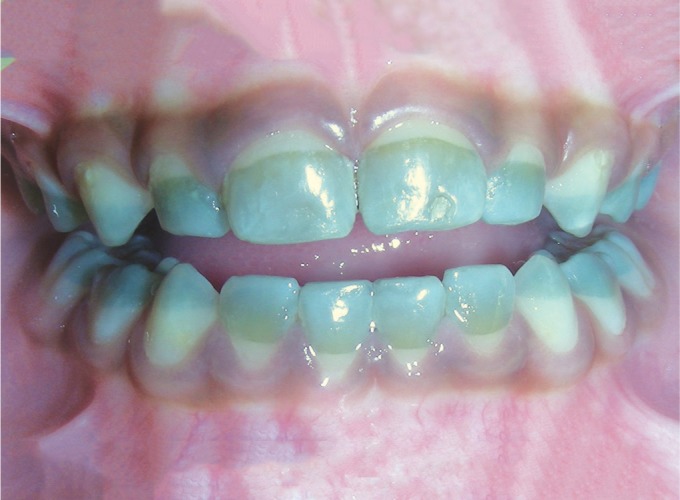 |
Congenital porphyria | Red, brown or purple-red discolouration | 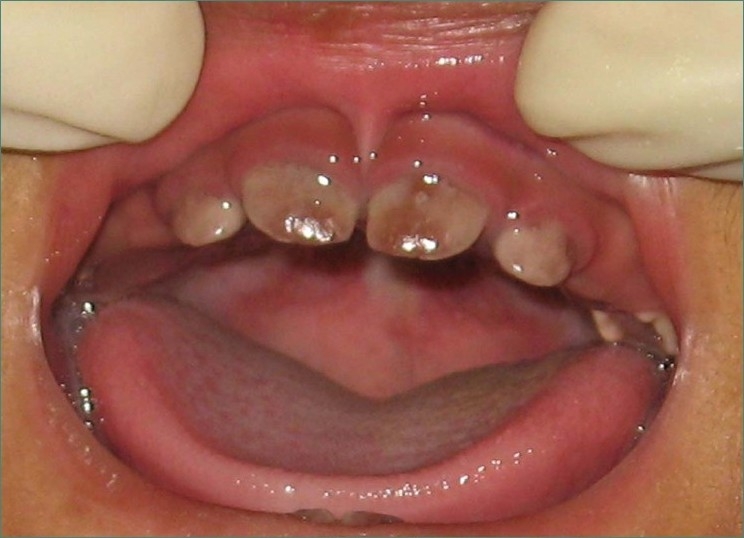 |
Tetracycline exposure during tooth development | Yellow-grey-brown intrinsic staining | 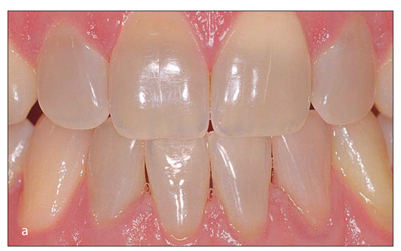 |