Clinical case
A 7-year-old boy attends because only a few teeth have erupted. His mother reports that he has sparse hair and struggles in hot weather because he sweats very little. Examination shows conical anterior teeth, dry skin and reduced alveolar ridge development.
Pathophysiology
Hypohidrotic ectodermal dysplasia affects tissues derived from ectoderm, including:
Teeth
Hair
Sweat glands
Skin
Nails
The most common form is X-linked, but autosomal dominant and autosomal recessive forms also occur. The dental features arise because tooth initiation and morphogenesis are disturbed. Teeth may be absent, delayed in eruption, small, pointed or conical. Reduced or absent sweat glands can cause impaired sweating, which can lead to dangerous hyperthermia, especially in infancy and childhood.
Epidemiology and Risk Factors
Non-modifiable | Modifiable |
|---|---|
Family history | No modifiable risk factors |
Male sex |
Clinical Features
The classic triad for hypohidrotic ectodermal dysplasia is:
Hypotrichosis (sparse hair)
Hypohydrosis or anhydrosis (reduced or absent sweating)
Symptoms | Signs | Image |
|---|---|---|
Missing teeth | Peg-shaped or conical teeth | 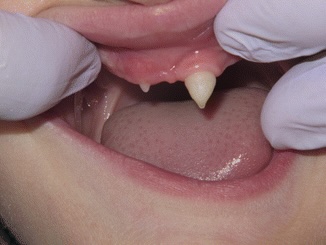 |
Delayed eruption | Hypodontia or anodontia | |
Heat intolerance | Reduced alveolar bone development | |
Sparse hair | Dry, smooth skin with reduced sweating | |
Sparse scalp or body hair | ||
Frontal bossing |
Investigations
Primary investigations:
Full dental and medical history
Family history
Clinical examination
Radiographs: OPG to assess tooth germs and eruption
Gold standard investigation:
Diagnosis is usually clinical, supported by dental radiographs and where needed, genetic testing.