Definition: Long-chain molecules built from repeating units (monomers)
Most “plastics” and “rubbers” you meet in dentistry are polymers, very long chains made by linking lots of small molecules (monomers). How those chains are made and arranged determines whether a material becomes a hard denture base, a flexible impression, or a tough composite filling.
Unlike metals or ceramics, polymers span both the natural and synthetic worlds. Nature’s own polymers (eg. collagen and DNA) are fundamental to life. Modern practice, however, relies heavily on synthetic polymers such as polyethylene and polypropylene and in dentistry, methacrylate resins and silicones. Today we design polymers to solve specific problems that didn’t previously have solutions; dialysis membranes, oxygenators, high-performance dental composites, and more.
Examples in dentistry:
Dental Material | Polymerisation | Key Points |
|---|---|---|
PMMA denture (heat-cure) | Addition, heat-activated benzoyl peroxide | Good strength, thermoplastic behaviour before cross-linking |
PMMA temporary (self-cure) | Addition, amine-peroxide | Faster set, lower degree of monomer conversion than heat-cure |
Light-cured composite | Addition, light-activated initiator system | Depth of cure depends on light, shade, filler; polymerisation shrinkage can occur |
Silicone impression | Addition or condensation cured | Elastomeric, cross-linking turns liquid polymers into dimensionally stable solids |
Monomers
A monomer is the starting molecule that repeats to form a chain. For polyethylene, the monomer is ethylene (–CH₂=CH₂–) and the repeat unit in the chain is -CH₂–CH₂–. Polypropylene is similar but carries a methyl (–CH₃) side group from the propylene monomer. That small difference matters: the methyl group can line up regularly on one side (isotactic), alternate (syndiotactic), or occur randomly (atactic). This “tacticity” affects how neatly chains pack, how crystalline a polymer can become, and ultimately its rigidity and melting behaviour.
Get a backbone
The backbone is the main chain of atoms in the polymer. In most resin composites this backbone is carbon-based (eg. methacrylates), while in silicones it is an Si-O-Si chain (eg. polydimethylsiloxaone). Changing the backbone changes flexibility and thermal behaviour. For example, polydimethylsiloxane has a very flexible Si-O backbone and is liquid at room temperature, whereas, the bulky monomers in bis-GMA give very rigid polymers.
If a polymer is built from one monomer we call it a homopolymer; use two or more, and you have a copolymer or heteropolymer.
How chains form: Two Routes to polymerisation
To form a polymer, we need to be able to link up monomers by covalent bonds. There are two main methods of achieving this: addition polymerisation and condensation polymerisation.
Addition polymerisation
This is a reaction between two molecules to produce a larger molecule without the elimination of a smaller molecule. This is usually achieved in a process of free-radical addition polymerisation, where a reactive molecule (a free radical) is generated to trigger a chain-reaction of polymerisation. Addition polymerisation has four stages (seen in figure 1):
Activation
Initiation
Propagation
Termination
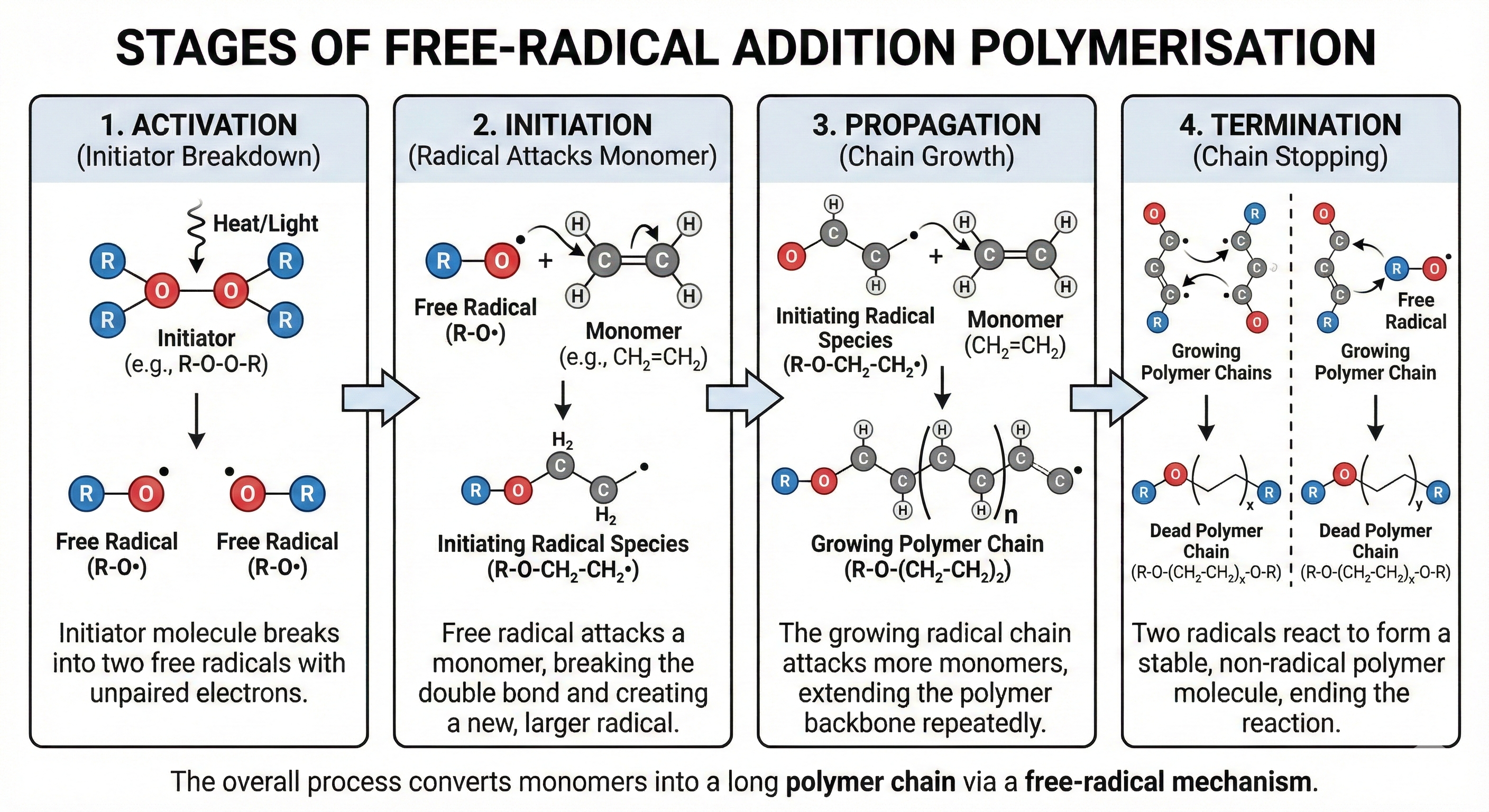
Activation
You start with a relatively stable molecule (called an initiator), such as benzoyl peroxide. In the activation process, the initiator is broken apart to form free radicals, which are highly reactive species with an unpaired electron (•). This can happen by the addition of heat (thermal decomposition), light or through a chemical reaction. Once these free radical exist they are ready to start the chain reaction.
How do we create radicals? In dentistry you’ll see three common triggers:
Heat: Benzoyl peroxide decomposes above ~65 °C and generates radicals → used in heat-cure PMMA denture bases.
Chemical (amine-peroxide): A tertiary amine activates benzoyl peroxide at room temperature → used in self-cure repair resins, temporary crowns, some chemically cured composites.
Light: Photoinitiators (eg. camphoroquinone) respond to blue light to start polymerisation → used in light-cured composites and adhesives.
Initiation
The newly formed highly reactive free radical adds to the C=C double bond of a monomer. The double bond then breaks and the radical attaches to one of the carbons. The unpaired electron shifts to the other carbon so the product is still a radical, but it is a radical at the end of the monomer unit. This allows the chain reaction to continue.
We go from a small radical + monomer → radical monomer unit (start of the chain). Dental specific examples are outlined below:
Radical add across the double bond in methyl methacrylate (MMA):
R• + MMA → R–(MMA)•
This is the first step in forming poly(methyl methacrylate) used in denture bases.
Radical formed from the light-activated photoinitiator attack the double bonds in dimethyacrylate monomers like bis-GMA starting a cross-linked network in resin composites.
Propagation
The radical at the end of the growing chain behaves just like the original radical; it attacks another monomer's C=C double bond. The chain-end radical adds to the double bond of the next monomer meaning the radical moves to the new chain end and so on. This process repeats many times, rapidly adding monomers.
So you get:
R–M• + M → R–M–M•
R–M–M• + M → R–M–M–M•
…and so on (M = monomer)
Termination
Polymerisation stops when the radical is destroyed or rendered non-reactive. Common mechanisms
Combination
Two radical chain ends meet and form a single covalent bond:
R–(M)ₙ• + R–(M)ₘ• → R–(M)ₙ–(M)ₘ–R
The result: one longer, dead polymer chain.
Disproportionation
One radical chain end abstracts a hydrogen atom from another radical chain giving one chain with a double bond at the end (unsaturated) and the other chain with a saturated end. Both are now non-radical and cannot propagate any further.
Reaction with inhibitors or oxygen
Radicals can react with oxygen to form less reactive peroxy radicals or with specific added inhibitors which can deliberately slow or stop polymerisation.
Since termination is random in time, different chains stop at different lengths resulting in a distribution of molecular weights. The result is a mixture of long chains, some short chains (oligomers) and some residual monomer.
Ionic polymerisation (cationic and anionic)
Not all addition polymerisation is driven by free radicals. Some monomers polymerise via ionic chain reactions, where the active growing chain end is a charged species rather than a radical. The basic stages are similar (initiation → propagation → termination), but the “reactive centre” is either a carbocation (cationic polymerisation) or a carbanion(anionic polymerisation). Ionic mechanisms are very fast and often highly sensitive to water and impurities because water can neutralise (quench) the charged chain end.
Cationic polymerisation (positive chain end)
What happens: an initiator/acid system generates a carbocation, typically by protonating a double bond or opening a strained ring. That positively charged chain end then adds to more monomer, growing the chain.
Simple scheme (generic):
Initiation (create a carbocation):
M + H+ → M+
Propagation (chain growth):
Mn+ + M → Mn+1+
Termination (quenching by a nucleophile/water):
Mn+ + H2O → Mn - H + H+