Definition: A resin is a liquid or solid that can be converted into a polymer. In the context of dentistry, a resin composite is a tooth‑coloured, adhesive restorative materials composed of a polymerisable organic resin matrix that surrounds and binds inorganic filler particles via a silane coupling agent. They are light‑ or dual‑cured and are bonded to enamel/dentine using an adhesive system.
Clinical Case
A 23-year-old patient presents with a chipped incisal edge on an upper central incisor after a sports injury. The tooth tests vital, there’s no pain, and the patient is mainly concerned about appearance before an upcoming event. You decide to restore the defect with a bonded resin composite, using minimal preparation, careful shade selection and incremental placement to rebuild the incisal edge so it blends seamlessly with the natural tooth.
Uses
Direct anterior and posterior restorations
Fissure sealants
Core build-ups and post/cores
Inlays, onlays and veneers
Luting of indirect restorations (resin cements)
How to use them in clinical practice
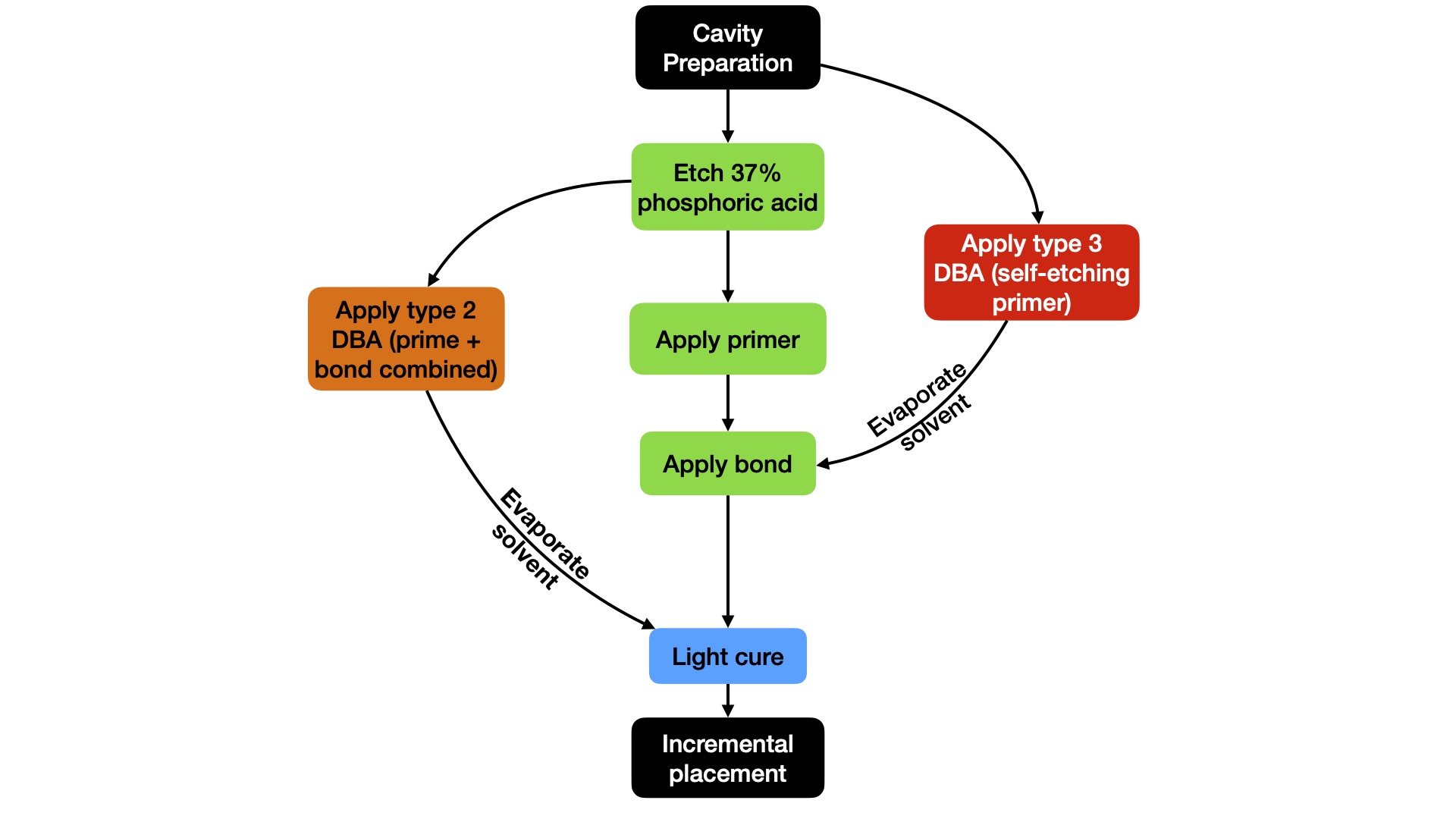
Tips:
Keep dentine visibly moist (glistening) for etch‑and‑rinse systems; avoid over‑drying.
Evaporate adhesive solvent thoroughly (gentle air)
Use incremental layering to reduce shrinkage stress; overlap light exposures on large surfaces.
Constituents
Resin matrix: Bis‑GMA and/or UDMA; low‑viscosity diluents (e.g., TEGDMA) to control handling
Inorganic filler: Silica/quartz or barium/strontium glass (radiopacity); particle sizes from nano (<100 nm) to micro (≤5–10 µm)
Coupling agent: Silane (e.g., 3-MPS also called γ‑MPTS) chemically links filler to resin
Initiator/accelerator: Camphorquinone (CQ) + amine for blue‑light activation; benzoyl peroxide/amine for chemical/dual cure
Inhibitors and stabilisers: e.g., BHT; UV/colour stabilisers
Pigments and opacifiers: Shade, opacity, fluorescence control; radiopacifiers (Ba, Sr, Zr)
Chemistry
What actually sets when we “cure” a composite?
The unset material is a syrup of (mostly) methacrylate monomers dissolved around and between solid filler particles. When blue light (470nm) hits the paste, the photoinitiator camphorquinone (CQ) absorbs a photon and is excited. In the presence of a co‑amine, CQ generates free radicals, high‑energy species that attack the carbon–carbon double bond (C=C) of a methacrylate group. This triggers a classic free‑radical chain reaction, known as addition polymerisation.
Initiation: light → CQ*; CQ* + amine → radicals; radicals open a monomer’s C=C.
Propagation: the growing polymer radical adds to more C=C bonds, cross‑linking dimethacrylates into a 3‑D network. Because most monomers (e.g., Bis‑GMA, UDMA, TEGDMA) carry two methacrylate groups, cross‑links form readily.
Termination: two radicals meet and deactivate (by combination or disproportionation).
Two kinetic landmarks matter clinically:
Gel point: the moment the network first spans the material and mobility plummets. Before gelation, the paste can flow and relax shrinkage; after gelation, stress rises quickly.
Vitrification: the network’s glass transition is exceeded (it “glasses”); diffusion slows, conversion creeps up only incrementally with further light.
Why does polymerisation cause shrinkage?
Polymerisation converts relatively far‑apart monomers into a tightly bonded network: average intermolecular distances shorten as C=C bonds become C–C single bonds and chains pack more efficiently. Net volumetric shrinkage ~1.5–3.5% is typical for methacrylates. Formulation levers that reduce shrinkage or stress:
Bigger monomers (Bis‑GMA, UDMA) → fewer molecules per unit volume react → less total bond‑distance collapse.
Higher filler loading → less resin volume available to shrink.
Reactive “modulators” in some bulk‑fills create more time for flow (stress‑decreasing resins) during the pre‑gel phase.
Note the distinction: shrinkage magnitude (vol%) and shrinkage stress (MPa) are related but not identical. Stress depends on cavity geometry (C‑factor), curing rate, elastic modulus development, and the adhesive constraint.
Light, dose, and depth of cure
Spectrum: CQ absorbs best ~465–480 nm. Most light cures are set to emit blue light of 470nm.
Irradiance × time = radiant exposure (dose). If irradiance at the resin surface is halved (distance, angulation, debris on tip), exposure time must roughly double to keep the same dose.
Optics in the composite: light is absorbed (by pigments/initiators) and scattered (by fillers). Matching the refractive index of resin and filler improves transmission. Dark/opaque shades and highly filled, opacified materials cure more shallowly than translucent “bulk‑fills.”
Practical take‑home: keep the light cure tip close and clean, overlap large areas, respect product‑specific exposure times (often longer for darker shades), and avoid curing through metal matrices without aids.
The oxygen‑inhibited layer (good, then bad)
Oxygen quenches free radicals at the very surface, leaving a microscopically sticky, uncured film. This is useful between increments to allow incremental layers of resin to bond to each other but for the final surface it can attract stain and wear. Wipe/polish or cure under glycerin gel to exclude O₂ for the last exposure.