Key Definitions
Term | Definition |
|---|---|
Adhesion | Force that binds dissimilar materials when brought into intimate contact at an interface |
Cohesion | Attraction within the same material |
Adhesive | Material that creates the bond |
Adherend/substrate | The surfaces being bonded |
Interface | Junction between adhesive and subtract |
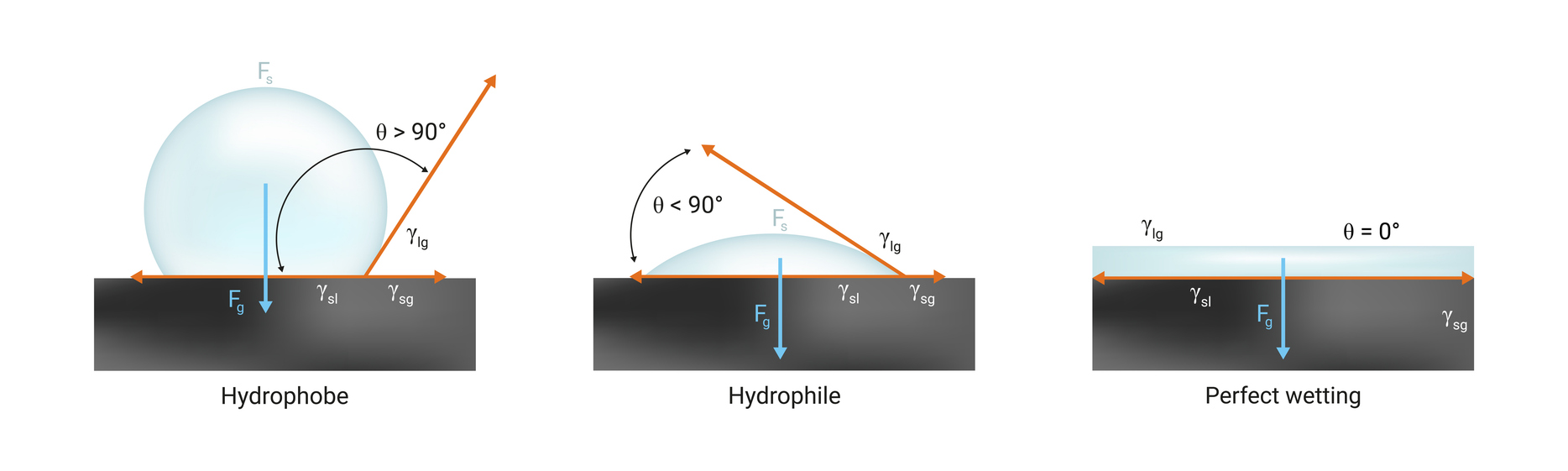
Wetting | How well a liquid spreads on a solid |
Contact angle | The angle formed at the point where a liquid droplet, a solid surface and the surrounding gas meet. A low contact angle indicates good wetting and strong adhesion |
Surface tension | The contractive force per unit length along a liquid's surface caused by cohesive forces between molecules.
|
Surface energy | The excess free energy per unit area of a solids's surface due to unsatisfied bonds at the surface.
|
Hybrid layer |
|
C-factor | Ratio of bonded surfaces to unbonded surfaces |
Adhesion is the force that binds dissimilar materials when they are brought into intimate contact at an interface. Cohesion is attraction within a single material. The bonding material is the adhesive; the bonded surfaces are the adherends (substrates); and the interface is where they meet. Two dry solids touch only at the tips of microscopic asperities, so direct solid-to-solid adhesion is poor; dentistry therefore introduces a fluid or semi-fluid adhesive to wet the surface, displace air, penetrate micro-irregularities, and then set into a solid that resists tensile and shear forces.
Getting intimate contact
Good bonds begin long before chemistry: they begin with contact. An apparently smooth solid is rough at the microscopic level, so the adhesive must spread across peaks and flow into fissures rather than “bridge” over them. Whether this happens depends on three linked factors:
Wettability. A liquid wets a solid when it spreads rather than beads. Wetting is described by the contact angle: lower angles mean better spreading, and perfect wetting corresponds to ~0°. Wetting improves when the liquid’s surface tension is lower than the solid’s surface energy. This is why hydrophobic resins do not naturally wet hydrophilic, moist dentine, and why surface preparation and primers are essential.
Examples:
Clean, etched enamel has high surface energy, so adhesive resins spread well on it.
Oily or contaminated surfaces have low surface energy, so liquids bead up and adhesion is poor.
Hydrophobic resins do not naturally wet moist hydrophilic dentine; primers are used to bridge this incompatibility.
Viscosity. Lower viscosity helps the adhesive flow into narrow crevices, displace air, and create a continuous film. Highly filled, stiff resins resist flow and can trap voids even if their base resin would otherwise wet the surface well. In capillary spaces, penetration improves as surface tension increases, contact angle decreases, and viscosity decreases.
Surface morphology. Controlled micro-roughness increases true contact area and, if undercuts are present, allows micromechanical interlocking—but only if the adhesive actually reaches those undercuts and sets there. Air entrapment negates the benefit of roughness.
A fourth, often overlooked, principle is cleanliness. Contaminants (saliva, blood, oils, eugenol, silicone residues, smear debris) sit between adhesive and tooth and block molecular contact. In practice, many failed bonds trace back to inadequate cleaning, poor isolation, or solvent evaporation rather than a “weak” material.
What actually holds materials together?
Once intimate contact is established, several mechanisms contribute, usually together rather than in isolation.
Mechanism | What is it | Needs | Dental Examples |
|---|---|---|---|
Mechanical interlocking | Adhesive fills micro-undercuts and then sets | Wetting, low viscosity, time before set | Acid-etched enamel resin tags |
Physical | van der Waals forces, hydrogen bonding | Intimate contact, polarity | Contributes to most bonds; weak alone |
Chemical | Ionic or covalent bonds across interface | Reactive groups on both sides | Glass ionomer cement |
Diffusion | Polymer chains interpenetrate across a softened zone | Solvent action, compatible chains | Fresh composite repair, hybrid layer in dentine |
Enamel bonding
Phosphoric-acid etching selectively dissolves enamel hydroxyapatite to create a high-energy, micro-undercut surface. Etch results in increased area and provide entry points for low-viscosity resin, which forms resin tags as it sets. Standard protocols use ~37% phosphoric acid for ≈15 seconds on cut enamel and 30–60 seconds on uncut enamel, removing about 5 µm of the surface (including pellicle and amorphous layers, and the smear layer on cut enamel). Thorough rinsing is followed by drying to a chalky frost, indicating a high-energy surface ready for bonding. Gel etchants tend to produce more uniform patterns than liquids and are easier to control. When placing sealants or bonding to enamel margins, an etch-and-rinse approach remains the reference standard; self-etch primers alone typically give lower enamel bond strengths unless combined with selective enamel etching.