Basic periodontal examination (BPE) screening:
- The Basic Periodontal Examination (BPE) is a rapid screening tool used to identify periodontal disease and determine the level of further periodontal assessment required.
- How to perform a BPE:
Dentition is divided into 6 sextants:
Sextant based evaluation – highest score is recorded for each (minimum of 2 teeth in a sextant to qualify. If one tooth is present in a sextant then the score for that tooth is included in the recording for the adjoining sextant):
Upper right: 17 to 14, upper anterior 13-23, upper left 24-27
Lower right: 47 to 44, lower anterior 43-33, lower left 34 to 37
All teeth in a sextant are examined (Third molars are usually excluded unless they replace second molars or are functioning teeth within the sextant).
A World Health Organisation (WHO) probe is used:
The probe has a 'ball end' (the ball is 0.5mm in diameter)
The probe has a black band from 3.5mm to 5mm
Two further markings at 8.5mm and 11.5mm
The probe is walked around the gingival sulcus or periodontal pockets of the tooth in each sextant with the highest score being recorded.
It is recommended a light probing force is used equating to 20-25g or 0.2-0.25N (equivalent to the force required to blanch a fingernail.)
The probe should cover all six sites of the tooth: distobuccal, mid-buccal, mesiobuccal, distolingual/ palatal, mid-lingual/palatal, mesiolingual/palatal
- When to perform a BPE:
All new patients
Codes 0-2 → a BPE should be performed at every routine examination (at least annually)
Can be used on adults and children
In children under 11 years, only BPE codes 0–2 should normally be recorded. This is due to the increased likelihood of pseudo-pocketing associated with erupting teeth. Any deep pockets identified should be investigated further.
All codes 0-4* can be used in 12-17 when permanent teeth erupt
BPE should not be used around implants
- BPE scoring codes:
Score | Description |
|---|---|
0 | No pockets >3.5 mm, no calculus/overhangs, no bleeding after probing (black band completely visible) |
1 | No pockets >3.5 mm, no calculus/overhangs, but bleeding after probing (black band completely visible) |
2 | No pockets >3.5 mm, but supra- or subgingival calculus/overhangs (black band completely visible) |
3 | Probing depth 3.5-5.5 mm (black band partially visible, indicating pocket of 4-5 mm) |
4 | Probing depth >5.5 mm (black band entirely within the pocket, indicating pocket of 6 mm or more) |
* | Furcation involvement |
Example of a BPE grid may look like:
3 | 1 | 4 |
|---|---|---|
- | 2 | 4* |
N.B. the dash indicates there wasn't sufficient teeth present within that sextant for evaluation
- BPE score recommendations:
Code 0 → no special tests required → no need for periodontal treatment
Code 1 → plaque and bleeding charts → oral hygiene instructions (OHI)
Code 2 → plaque and bleeding charts → OHI + removal of plaque retentive factors (including supra and subgingival calculus)
Code 3 → plaque and bleeding charts, and consideration of radiographs → Initial therapy which includes OHI and risk factor control, then post-therapy (normally ~ 6 weeks later) 6-point pocket chart in that sextant
Code 4 → plaque and bleeding charts, and radiographs → Record a 6-point pocket chart throughout the entire dentition.
Radiographs should be available for all code 3 and code 4 sextants. Type of radiograph is a clinician's judgement however many textbooks would say:
Bitewings → best for early bone loss
Periapicals → best for advanced disease
Periodontally radiographs should be used to assess for:
Degree of bone loss
Pattern or type of bone loss
Presence of furcation defects
Presence of subgingival calculus
Other features: perio-endo lesions, widening of PDL spaces, abnormal root length, overhanging restorations
2017 classification of periodontal and peri-implant diseases and conditions:
- Provides a structured framework to accurately diagnose and stage periodontal disease.
- Looks at 4 main categories:
Periodontal health, gingival disease, and conditions
Periodontitis
Other conditions affecting the periodontium (e.g. mucogingival deformities, periodontal abscess, traumatic occlusal forces)
Peri-implant disease and conditions (e.g. peri-implant mucositis, soft/hard tissue deficiencies)
- Allows for staging and grading within the above categories. This allows for tailored treatment plans that are consistent between clinicians.
- Focus’ on risk factors which emphasises prevention and disease control.
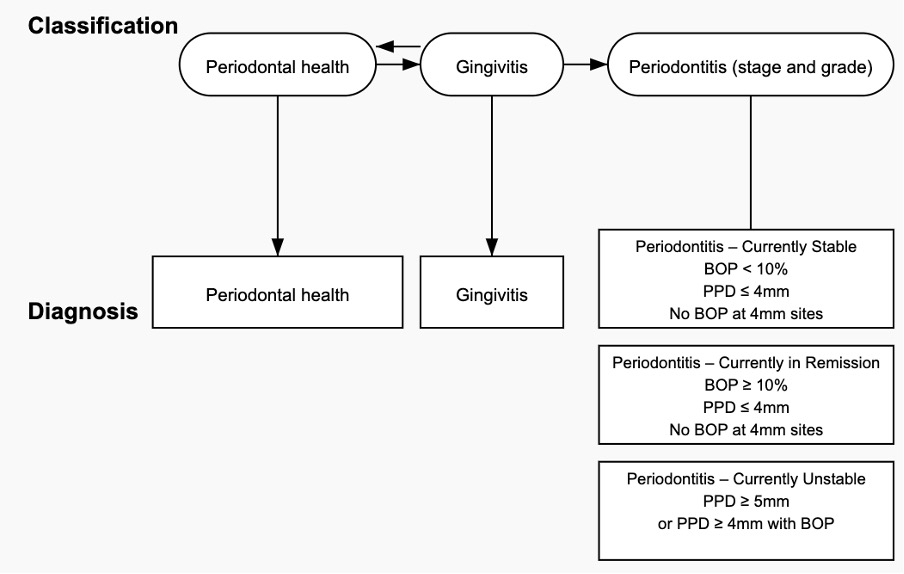
Classification of periodontal disease:
- Periodontal health:
Clinically: absence of clinical inflammation, no bleeding on probing (or minimal <10% sites). Typically code 0 on BPE.
Important as baseline reference for diagnosing gingival disease.
- Plaque induced gingivitis:
Clinically: inflammation(redness/swelling), bleeding on probing. Typically codes 1-2 on BPE (if no attachment loss).
Is caused by the host inflammatory response to dental plaque biofilm accumulation at the gingival margin.
Importantly REVERSIBLE with good oral hygiene/improved plaque control